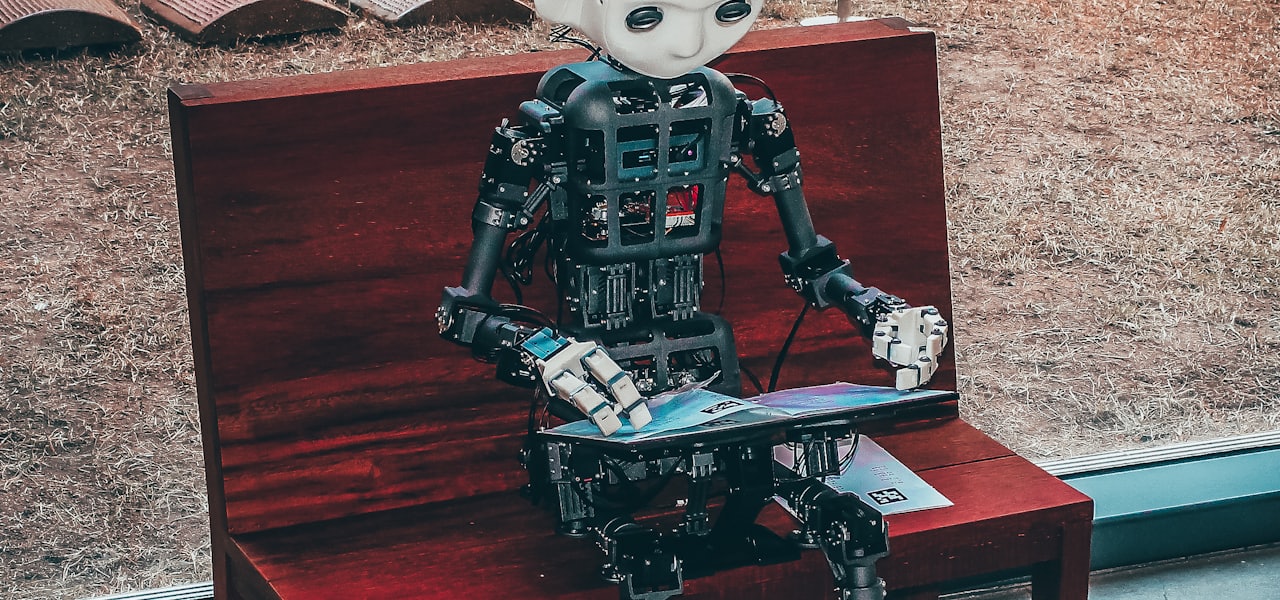
An emergent algorithm is an algorithm that exhibits emergent behavior. In essence an emergent algorithm implements a set of simple building block behaviors that when combined exhibit more complex behaviors. One example of this is the implementation of fuzzy motion controllers used to adapt robot movement in response to environmental obstacles. An emergent algorithm has the following characteristics: it achieves predictable global effects it does not require global visibility it does not assume any kind of centralized control it is self-stabilizing Other examples of emergent algorithms and models include cellular automata, artificial neural networks and swarm intelligence systems (ant colony optimization, bees algorithm, etc.).
Objective vision
Objective Vision (Object Oriented Visionary) is a project mainly aimed at real-time computer vision and simulation vision of living creatures. it has three sections containing an open-source library of programming functions for using inside the projects, Virtual laboratory for scholars to check the application of functions directly and by command-line code for external and instant access, and the research section consists of paperwork and libraries to expand the scientific prove of works. == Background == The process has been used in the OVC libraries is as same as what's happening when living see a picture, and it's designed to give the researchers to experience the brain's visual cortex most close simulation for picture perception. The OVC was designed to work as a simulated visual cortex that has a critical job in processing and classify the objects to make it easier to work with pictures and graphical perception and processing. The human brain is much more aware of how it solves complex problems such as playing chess or solving algebra equations, which is why computer programmers have had so much success building machines that emulate this type of activity. but when the whole process is still a riddle that how the entities visionary system works. The project was simulated the visionary system by how it starts to convert the signals to image(actually the edges and colors) and then recognizing the shapes to find a relation between brain's information and image. The Objective Visionary system actually is concentrating on the separable sections, this separation gives the application visionary system the excellence processing result, because with this method the system do not waste much time on processing non significant sections and signals. this operation in the Objective Vision project called objective processing and because the O.V. mission is focused on human visionary simulation, so the developer refers with Objective Vision. == History == Objective-Vision is a Human (Natural) Visionary simulation Project developed by Michael Bidollahkhany. Following an explosion of interest during the 21st century were characterized by the maturing of the field and the significant growth of active applications; simulation of visionary systems, visionary based autonomous vehicle guidance, medical imaging (2D and 3D) and automatic surveillance are the most rapidly developing areas. This progress can be seen in an increasing number of software and hardware products on the market, as well as in a number of digital image processing software and APIs and also machine vision courses offered at universities worldwide. Therefore, the OVC project has been released as a research software project in 2016. One of important parts of this project was O.V.C. (Objective Vision Class library), that was designed to able companies and scientists to use the brain's most likely functionalities as visionary libraries to simplify and accelerate the image processing algorithms developments. The project started under MIT copyright license, but since 2018 the project continued as classified based on sponsors opinion. == The Algorithm == As developers claimed the algorithm used in the class library and developer's kit of project has been developed based on natural visionary system, and the functionalities containing image processing, optimization and labeling etc. are mostly upgraded and near techniques. Suppose that we've a picture of a jungle, or somewhere else, with this library developer will be able to manipulate not only the pixel of images for data extraction, but automatically based on which algorithm is used and image quality, he can manipulate directly a list of objects, same pixels and every data project needs to have, said the developer in his lecture answering how the algorithm works. === Viewpoint === For long times digital image processing and storing, was actually by processing just pixels; this Project tries to present a new kind of image processing and even storing, "objective vision" or "object-oriented visionary" is called. This project officially launched in May 2016, with the aim of making more adaptation between Computer Vision (Include Visionary, Digital image processing, discernment and even Perception) and Human Visual System; about development of the project: "...so we decided to research on Human Vision System, besides we worked on Artificial Retinal image processing and new visionary optimization unit(Presented at Istanbul Technical University Conference(Turkey 2015-2016)) and grew our research to Visionary CORTEX of Brain", Michael Bidollahkhany said. == Applications == The OVC application areas include: 2D and 3D feature toolkits Egomotion estimation Human–computer interaction (HCI) Mobile robotics Motion understanding Object identification Segmentation and recognition Stereopsis stereo vision: depth perception from two cameras Structure from motion (SFM) Motion tracking == Programming language == In first initial release of Objective Visionary Project the algorithm has been written in C++ and C#, and the virtual laboratory has been developed in C# and Delphi. Based on developers last lecture since the second release the complete algorithm has been re-written in C# based on .Net Core 1.0 to make it easier to work on different operating systems.
METEO System
The METEO System is a machine translation system specifically designed for the translation of the weather forecasts issued daily by Environment Canada. The system was used from 1981 to 30 September 2001 by Environment Canada to translate forecasts issued in French in the province of Quebec into English and those issued in English in other Canadian provinces into French. Since then, a competitor program has replaced METEO System after an open governmental bid. The system was developed by John Chandioux and was often mentioned as one of the few success stories in the field of machine translation. == History == The METEO System was in operational use at Environment Canada from 1982 to 2001. It stems from a prototype developed in 1975–76 by the TAUM Group, known as TAUM-METEO. The initial motivation to develop that prototype was that a junior translator came to TAUM to ask for help in translating weather bulletins at Environment Canada. Since all official communications emanating from the Canadian government must be available in French and English, because of the Official Languages Act of 1969, and weather bulletins represent a large amount of translation in real time, junior translators had to spend several months producing first draft translations, which were then revised by seniors. That was a difficult and tedious job, because of the specificities of the English and French sublanguages used, and not very rewarding, as the lifetime of a bulletin is only 4 hours. TAUM proposed to build a prototype MT system, and Environment Canada agreed to fund the project. A prototype was ready after a few months, with basic integration in the workflow of translation (source and target bulletins travelled over telex lines at the time and MT happened on a mainframe computer). The first version of the system (METEO 1) went into operation on a Control Data CDC 7600 supercomputer in March 1977. Chandioux then left the TAUM group to manage its operation and improve it, while the TAUM group embarked on a different project (TAUM-aviation, 1977–81). Benoit Thouin made improvements to the initial prototype over the subsequent year, and turned it into an operational system. After three years, METEO 1 had demonstrated the feasibility of microcomputer-based machine translation to the satisfaction of the Canadian government's Translation Bureau of Public Works and Government Services Canada. METEO 1 was formally adopted in 1981, replacing the junior translators in the workflow. Because of the need for high-quality translation, the revision step, done by senior translators, was maintained. The quality, measured as the percentage of edit operations (inserting or deleting a word counts as 1, replacing as 2) on the MT results, reached 85% in 1985. Until that time, the MT part was still implemented as a sequence of Q-systems. The Q-systems formalism is a rule-based SLLP (Specialized Language for Linguistic Programming) invented by Alain Colmerauer in 1967 as he was a postdoc coopérant at the TAUM group. He later invented the Prolog language in 1972 after returning to France and becoming a university professor in Marseille-Luminy. As the engine of the Q-systems is highly non-deterministic, and the manipulated data structures are in some ways too simple, without any types such as string or number, Chandioux encountered limitations in his efforts to raise translation quality and lower computation time to the point he could run it on microcomputers. In 1981, Chandioux created a new SLLP, or metalanguage for linguistic applications, based on the same basic algorithmic ideas as the Q-systems, but more deterministic, and offering typed labels on tree nodes. Following the advice of Bernard Vauquois and Colmerauer, he created GramR, and developed it for microcomputers. In 1982, he could start developing in GramR a new system for translating the weather bulletins on a high-end Cromemco microcomputer. METEO 2 went into operation in 1983. The software then ran in 48Kb of central memory with a 5Mb hard disk for paging. METEO 2 was the first MT application to run on a microcomputer. In 1985, the system had nothing left of the initial prototype, and was officially renamed METEO. It translated about 20 million words per year from English into French, and 10 million words from French into English, with a quality of 97%. Typically, it took 4 minutes for a bulletin in English to be sent from Winnipeg and come back in French after MT and human revision. In 1996, Chandioux developed a special version of his system (METEO 96) which was used to translate the weather forecasts (different kinds of bulletins) issued by the US National Weather Service during the 1996 Summer Olympics in Atlanta. The last known version of the system, METEO 5, dates from 1997 and ran on an IBM PC network under Windows NT. It translated 10 pages per second, but was able to fit into a 1.44Mb floppy disk.
Deepti Gurdasani
Deepti Gurdasani is a British-Indian clinical epidemiologist and statistical geneticist who is a senior lecturer in machine learning at the Queen Mary University of London. Her research considers the genetic diversity of African Populations. Throughout the COVID-19 pandemic, Gurdasani has provided the public with her analysis of the evolving situation mainly on the Twitter platform. == Early life and education == Gurdasani was an undergraduate and medical student at the Christian Medical College Vellore at Tamil Nadu Dr. M.G.R. Medical University. After earning her medical degree and qualifying in internal medicine, she moved to the United Kingdom, where she worked toward a research doctorate in genetic epidemiology at Wolfson College, Cambridge. Her doctoral research involved the design of strategies to understand complex diseases in diverse populations. == Research and career == In 2013, Gurdasani joined the Wellcome Sanger Institute as a postdoctoral fellow, where she worked on the genomic diversity of African populations and how this diversity impacts susceptibility to disease. She makes use of dense genotypes and whole genome sequences to better understand how population movements determined genetic structure. In particular, Gurdasani develops machine learning algorithms to large-scale clinical data sets. At the Sanger Gurdasani co-led the African Genome Variation Project and the Uganda Resource Project. Gurdasani moved to Queen Mary University of London in 2019, where she created deep learning approaches for clinical prediction and the identification of novel, genome-based drug targets. During the COVID-19 pandemic Gurdasani has provided public commentary on the pandemic, making use of both Twitter and print media to share information on the evolving situation. She has researched the incidence of long covid in the UK. In 2021 Gurdasani started to write for The Guardian. == Selected publications == Deepti Gurdasani; Tommy Carstensen; Fasil Tekola-Ayele; et al. (3 December 2014). "The African Genome Variation Project shapes medical genetics in Africa". Nature. 517 (7534): 327–332. doi:10.1038/NATURE13997. ISSN 1476-4687. PMC 4297536. PMID 25470054. Wikidata Q34979569. Nisreen A Alwan; Rochelle Ann Burgess; Simon Ashworth; et al. (15 October 2020). "Scientific consensus on the COVID-19 pandemic: we need to act now". The Lancet. doi:10.1016/S0140-6736(20)32153-X. ISSN 0140-6736. PMC 7557300. PMID 33069277. Wikidata Q100697134. Deepti Gurdasani; Inês Barroso; Eleftheria Zeggini; Manjinder S Sandhu (24 June 2019). "Genomics of disease risk in globally diverse populations". Nature Reviews Genetics. 20 (9): 520–535. doi:10.1038/S41576-019-0144-0. ISSN 1471-0056. PMID 31235872. Wikidata Q93000887. (erratum)
AI Video Editors Reviews: What Actually Works in 2026
Curious about the best AI video editor? An AI video editor is software that uses machine learning to help you get more done — it combines speed, accuracy, and an interface that just works. Hands-on testing shows real-world results vary, so a short free trial is the smartest way to decide. Whether you are a beginner or a pro, the right AI video editor slots into your workflow and pays for itself fast. Read on for hands-on impressions, pricing tiers, and the standout features that matter.
Load file
A load file in the litigation community is commonly referred to as the file used to import data (coded, captured or extracted data from ESI processing) into a database; or the file used to link images. These load files carry commands, commanding the software to carry out certain functions with the data found in them. Load files are usually ASCII text files that have delimited fields of information. Such load files may have data about documents to be imported into a document management software such as Concordance or Summation. Or they may have the path or directory where images may reside so that the software can link such images to their corresponding records. Some database programs take one load file for importing images and another for importing data while others take only one load file for both pieces of information. OCR or Search-able Text which is considered "data" is also imported into most database programs via the same load files. Though some people prefer to load the OCR into their databases by running a separate command to search and find the desired text. Commonly used databases and their corresponding file extensions are: Summation (DII , CSV), Concordance (OPT, DAT), Sanction (SDT), IPRO (LFP), Ringtail (MDB) and DB/TextWorks (TXT).
Markov chain
In probability theory and statistics, a Markov chain or Markov process is a stochastic process describing a sequence of possible events in which the probability of each event depends only on the state attained in the previous event. Informally, this may be thought of as, "What happens next depends only on the state of affairs now." A countably infinite sequence, in which the chain moves state at discrete time steps, gives a discrete-time Markov chain (DTMC). A continuous-time process is called a continuous-time Markov chain (CTMC). Markov processes are named in honor of the Russian mathematician Andrey Markov. Markov chains have many applications as statistical models of real-world processes. They provide the basis for general stochastic simulation methods known as Markov chain Monte Carlo, which are used for simulating sampling from complex probability distributions, and have found application in areas including Bayesian statistics, biology, chemistry, economics, finance, information theory, physics, signal processing, and speech processing. The adjectives Markovian and Markov are used to describe something that is related to a Markov process. == Principles == === Definition === A Markov process is a stochastic process that satisfies the Markov property (sometimes characterized as "memorylessness"). In simpler terms, it is a process for which predictions can be made regarding future outcomes based solely on its present state and—most importantly—such predictions are just as good as the ones that could be made knowing the process's full history. In other words, conditional on the present state of the system, its future and past states are independent. A Markov chain is a type of Markov process that has either a discrete state space or a discrete index set (often representing time), but the precise definition of a Markov chain varies. For example, it is common to define a Markov chain as a Markov process in either discrete or continuous time with a countable state space (thus regardless of the nature of time), but it is also common to define a Markov chain as having discrete time in either countable or continuous state space (thus regardless of the state space). === Types of Markov chains === The system's state space and time parameter index need to be specified. The following table gives an overview of the different instances of Markov processes for different levels of state space generality for both discrete and continuous time: Note that there is no definitive agreement in the literature on the use of some of the terms that signify special cases of Markov processes. Usually the term "Markov chain" is reserved for a process with a discrete set of times, that is, a discrete-time Markov chain (DTMC), but a few authors use the term "Markov process" to refer to a continuous-time Markov chain (CTMC) without explicit mention. In addition, there are other extensions of Markov processes that are referred to as such but do not necessarily fall within any of these four categories (see Markov model). Moreover, the time index need not necessarily be real-valued; like with the state space, there are conceivable processes that move through index sets with other mathematical constructs. Notice that the general state space continuous-time Markov chain is general to such a degree that it has no designated term. While the time parameter is usually discrete, the state space of a Markov chain does not have any generally agreed-on restrictions: the term may refer to a process on an arbitrary state space. However, many applications of Markov chains employ finite or countably infinite state spaces, which have a more straightforward statistical analysis. Besides time-index and state-space parameters, there are many other variations, extensions and generalizations (see Variations). For simplicity, most of this article concentrates on the discrete-time, discrete state-space case, unless mentioned otherwise. === Transitions === The changes of state of the system are called transitions. The probabilities associated with various state changes are called transition probabilities. The process is characterized by a state space, a transition matrix describing the probabilities of particular transitions, and an initial state (or initial distribution) across the state space. By convention, we assume all possible states and transitions have been included in the definition of the process, so there is always a next state, and the process does not terminate. A discrete-time random process involves a system which is in a certain state at each step, with the state changing randomly between steps. The steps are often thought of as moments in time, but they can equally well refer to physical distance or any other discrete measurement. Formally, the steps are the integers or natural numbers, and the random process is a mapping of these to states. The Markov property states that the conditional probability distribution for the system at the next step (and in fact at all future steps) depends only on the current state of the system, and not additionally on the state of the system at previous steps. Since the system changes randomly, it is generally impossible to predict with certainty the state of a Markov chain at a given point in the future. However, the statistical properties of the system's future can be predicted. In many applications, it is these statistical properties that are important. == History == Andrey Markov studied Markov processes in the early 20th century, publishing his first paper on the topic in 1906. Markov processes in continuous time were discovered long before his work in the early 20th century in the form of the Poisson process. Markov was interested in studying an extension of independent random sequences, motivated by a disagreement with Pavel Nekrasov who claimed independence was necessary for the weak law of large numbers to hold. In his first paper on Markov chains, published in 1906, Markov showed that under certain conditions the average outcomes of the Markov chain would converge to a fixed vector of values, so proving a weak law of large numbers without the independence assumption, which had been commonly regarded as a requirement for such mathematical laws to hold. Markov later used Markov chains to study the distribution of vowels in Eugene Onegin, written by Alexander Pushkin, and proved a central limit theorem for such chains. In 1912 Henri Poincaré studied Markov chains on finite groups with an aim to study card shuffling. Other early uses of Markov chains include a diffusion model, introduced by Paul and Tatyana Ehrenfest in 1907, and a branching process, introduced by Francis Galton and Henry William Watson in 1873, preceding the work of Markov. After the work of Galton and Watson, it was later revealed that their branching process had been independently discovered and studied around three decades earlier by Irénée-Jules Bienaymé. Starting in 1928, Maurice Fréchet became interested in Markov chains, eventually resulting in him publishing in 1938 a detailed study on Markov chains. Andrey Kolmogorov developed in a 1931 paper a large part of the early theory of continuous-time Markov processes. Kolmogorov was partly inspired by Louis Bachelier's 1900 work on fluctuations in the stock market as well as Norbert Wiener's work on Einstein's model of Brownian movement. He introduced and studied a particular set of Markov processes known as diffusion processes, where he derived a set of differential equations describing the processes. Independent of Kolmogorov's work, Sydney Chapman derived in a 1928 paper an equation, now called the Chapman–Kolmogorov equation, in a less mathematically rigorous way than Kolmogorov, while studying Brownian movement. The differential equations are now called the Kolmogorov equations or the Kolmogorov–Chapman equations. Other mathematicians who contributed significantly to the foundations of Markov processes include William Feller, starting in 1930s, and then later Eugene Dynkin, starting in the 1950s. == Examples == Mark V. Shaney is a third-order Markov chain program, and a Markov text generator. It ingests the sample text (the Tao Te Ching, or the posts of a Usenet group) and creates a massive list of every sequence of three successive words (triplet) which occurs in the text. It then chooses two words at random, and looks for a word which follows those two in one of the triplets in its massive list. If there is more than one, it picks at random (identical triplets count separately, so a sequence which occurs twice is twice as likely to be picked as one which only occurs once). It then adds that word to the generated text. Then, in the same way, it picks a triplet that starts with the second and third words in the generated text, and that gives a fourth word. It adds the fourth word, then repeats with the third and fourth words, and so on. Random walks based on integers and the gambler's ruin problem are ex